

TEEN Snapshot — January 2026
What Teens Value 2025
Through this original research series, CSS elevates youth voices and generates up-to-date, actionable, and thought-provoking research insights for storytellers seeking to authentically represent, positively impact, and capture the attention of young audiences. Learn more here.
View our press release for this project on UCLA’s newsroom here.
Key Takeaways
Safety is the Foundation for Everything Else Adolescents Want
Teens Choose Kindness and Empathy in a Polarized World
Adolescents Prioritize Self-Acceptance–And Media Can Help Them See Themselves Clearly
Fun is a Tool for Coping and Connection, Not Just Entertainment
This year, young people have navigated climate disasters, global geopolitical conflict, and severe economic strain, yet their values highlight how grounded they remain and how much they already understand about what they need.
In August of 2025, we collected the data for our second annual Teen Values Report, a regular feature of our Research Snapshot series, where we asked 1500 young people from across the country between the ages of 10 and 24 to rate the importance of 14 priorities—ranging from “being kind to others” to “being famous.” This year, young people again placed safety at the very top of their list, signaling a continued need for stability in a time of heightened social, political, and environmental volatility.
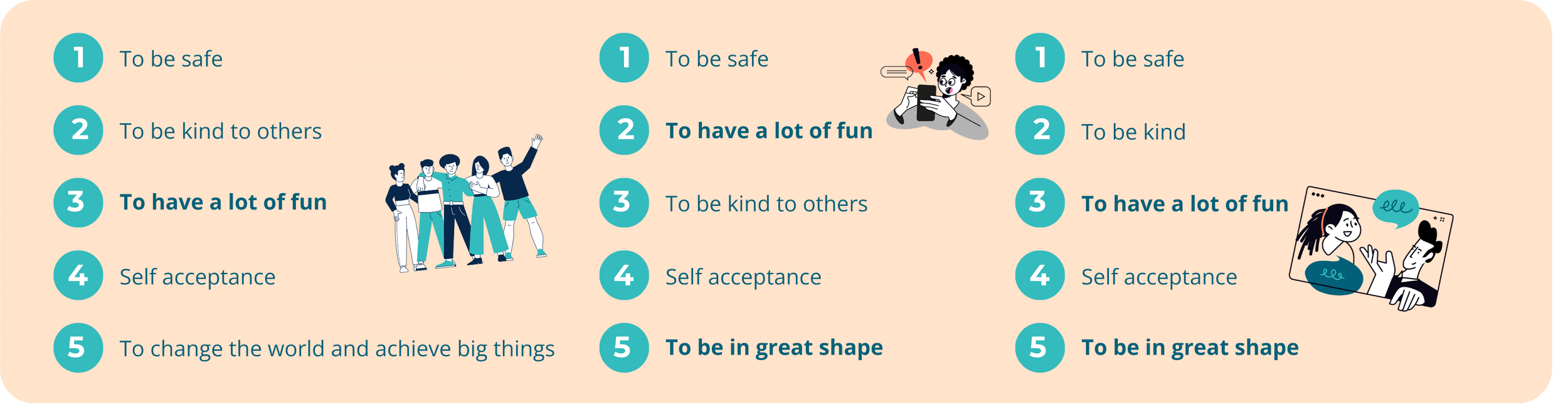
The values of kindness to others and self-acceptance rose as the second and third most important, demonstrating that adolescents are turning both outward toward community and inward toward identity and self-worth. These two values are mutually reinforcing—young people want to treat others well as much as they want to feel comfortable with the person they are.
Self-acceptance replaced last year’s third ranking of “to have a lot of fun.” This shift may reflect adolescents’ responses to an environment shaped by ongoing social, environmental, and media pressures, where internal stability and self-worth are becoming as important as external enjoyment.
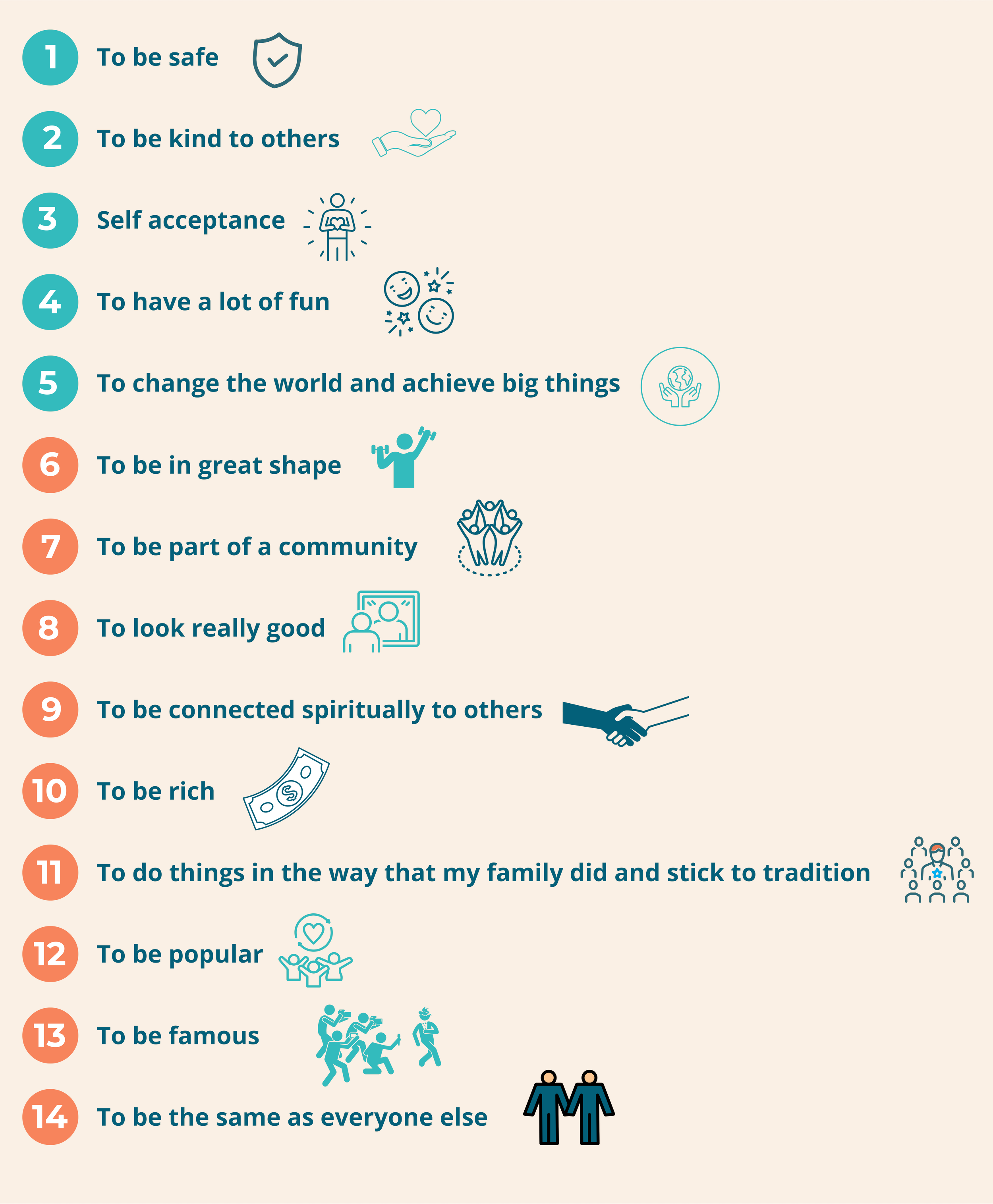
Ranking of What Teens Value Most
Safety is the Foundation for Everything Else Adolescents Want
Safety, once again, emerged as the top-ranked value among young people, signaling that even as culture, platforms, and preferences shift, security and stability continue to anchor adolescents’ worldview. Last year’s values snapshot highlighted that safety is both a basic need and an emotional state that underpins well-being.
This year’s findings strengthen that conclusion. In a media environment full of uncertainty—global conflict, school safety anxieties, digital harassment—young people are seeking content, communities, and experiences that make them feel steady, grounded, and protected. In other national surveys of young Americans, nearly three-quarters say the political system is rigged for the wealthy, 73 percent say leaders don’t really listen, and large majorities say everyday life feels harder than it should.
CSS’s broader research reinforces this pattern. In our recent report Heroes Like Us?, the character virtue adolescents associated most frequently with their favorite heroes was bravery, which is a value closely tied to safety given that heroes demonstrate bravery in order to restore safety. In addition, our 2025 Teens and Screens survey revealed that “Uplifting Stories” was the #2 ranked topic among adolescents, showing their desire for media that pulls them out of stress and offers some comfort and emotional reassurance.
Even their platform choices mirror a values-driven approach to content consumption and engagement. According to our 2025 Teens and Screens report, when teens want to “escape and forget about stress or problems,” they turn to video games (29.6%) or YouTube (21.3%), while “motivation or inspiration” comes from social media (31%) and YouTube (29.3%).
Safety, then, is a core value among adolescents that also shapes how they navigate media ecosystems to meet their emotional needs.

Check out our “Comfort Watching” Teen Snapshot to see what content adolescents turn to in times of stress.
Teens Choose Kindness and Empathy in a Polarized World
“Being kind to others” came in as the second most important value this year, reflecting both their desire to be treated with empathy and their commitment to treating others well. In a year marked by a rise in violent acts and hostile rhetoric rooted in ideological division and the persistent threat of gun violence in schools, young people may be responding to this climate by elevating “to be kind to others” as their second-highest value and signaling a collective desire to counter division with empathy, connection, and humanity.
In our Heroes Like Us? report, “being a good friend” was one of the top three virtues young people associated with the characters they admire.

In our recent Teen Snapshot on adolescents’ perceptions of systems-facing youth, we found that narrative exposure and media representation has the power to “bridge the empathy gap” among young viewers.
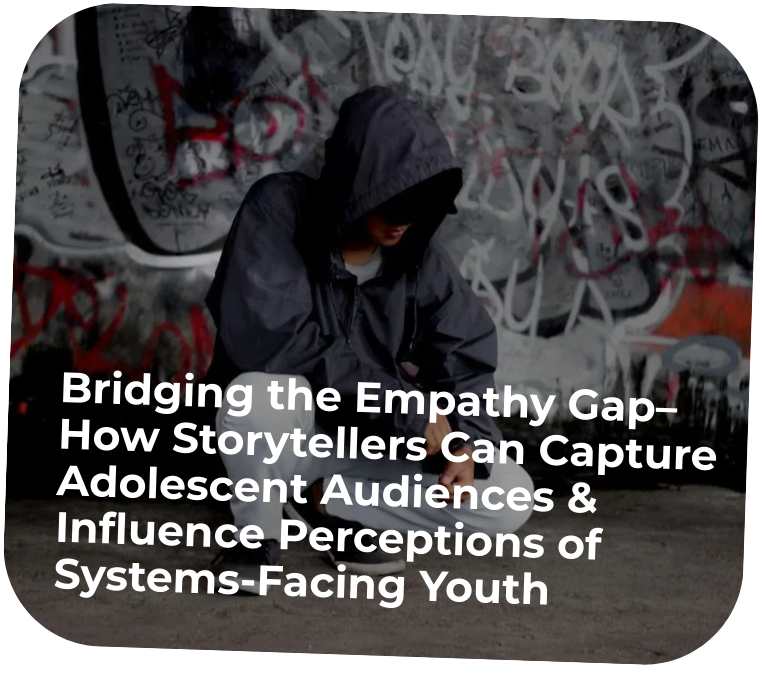
By reflecting adolescent values like kindness, media can not only strengthen empathy but also resonate more deeply with young audiences and capture their attention by modeling the kind of world they hope to create and be part of.
Adolescents Prioritize Self-Acceptance–And Media Can Help Them See Themselves Clearly
Ranked as the third-most-important value, self-acceptance reflects adolescents’ desire to understand and embrace who they are in a digital world where they are constantly evaluated.
Developmentally, this makes sense. Adolescence is a period of identity formation, and self-acceptance becomes crucial for mental health and self-definition. This value’s resonance with young people also has implications for storytellers–young people want media that helps them see themselves clearly, not ones that distort or elevate some version of “ideal” they cannot identify with.
In this year's Teens and Screens report, “people with lives like my own” ranked #1 among the list of story and character types adolescents want to see most.
This year, YouTube was again voted the most “authentic” platform, with nearly two-thirds rating it “often” or “always authentic,” which continues to indicate that young people seek spaces where they feel accurately represented, and that they are actively curating the media they consume to protect and support their mental, emotional, and psychological well-being.
What does authenticity mean to young people? We asked teens about their perceptions of representations of adolescents and modern friendship on screen in our research report Beyond Nomance: Rewriting Romance and Rethinking Teen Friendship on Screen.
Fun is a Tool for Coping and Connection, Not Just Entertainment
Although “to have a lot of fun” ranked fourth overall, it was significantly more important to younger adolescents between 10 and 13, teens 14–18, and boys, signaling that entertainment is still a vital emotional release and tool for social bonding–its how young people cope, connect, and breathe under immense psychological and emotional pressure.
Ages 10-13
Ages 14-18
Ages 10-24
Younger adolescents
Boys & Men
Middle adolescents
Teens are intentional about incorporating fun into their media habits and for many, fun is as much about shared experience as personal enjoyment. They aren’t always simply seeking to escape—laughter, play and joy are part of how they cope with stress and nurture meaningful peer relationships.
In this year’s teens and screens survey, we found that young people bond over entertainment media like TV and movies more than other kinds of content like social media or video games. And, when asked what activities they would choose if time and money weren’t a factor, adolescents ranked “seeing a new movie in theaters” as their #1 weekend activity—CHECK OUT THE REPORT.
Want to learn more about the role media plays in building and nurturing modern teen friendships? Check out our Borrow My Eyes Video Series.

Many of our findings this year suggest that the next generation is dealing with a world in turmoil by actively curating their internal and external lives. They want spaces and environments in which they can feel safe, relationships and interactions in which they can be kind and receive kindness, self-understanding that allows them to accept who they are, and restorative experiences on and offline through which they can breathe, laugh, and connect.
Authors
-

Yalda T. Uhls, PhD
Founder & CEO
-

Alisha J. Hines, PhD
Vice President, Research & Programs
-

Matt Puretz, M.A.
Senior Researcher
Acknowledgements
Many thanks to the members of the CSS team that made this project possible, including our fantastic intern Vahe Deverian and our Senior Marketing and Development Manager, Haidy Mendez, for designing this webpage.
Thank you to every youth participant who took the time to lend us their voice and share their thoughts. We are continuously grateful for your participation and insight.
Finally, this research would not be possible without generous support from our funders including FAST (Funders for Adolescent Science Translation), the Conrad N. Hilton Foundation, the Templeton World Charity Foundation, the Nielsen Foundation, Roblox, and the Warner Bros. Television Group.
Methodology
-
The aim of the survey was to better understand adolescents’ (age 10 to 24) relationship to entertainment media, including what types of media they use, how they use and feel about them, what their media preferences and priorities are, and most relevant to this report, what they value most. To do this, we asked 51 questions on a variety of topics, including asking them to rate how important 14 different values are on a scale from 1 (“Not important at all”) to 5 (“Extremely important”). These ratings were used to calculate a rank-order of importance to capture what values adolescents care most about.
-
The sample consisted of 1,500 U.S. adolescents, ages 10-24, with 100 respondents in each age cohort from 10 to 24. The racial demographics of the sample were approximately matched to the U.S. Gen Z racial and ethnicity demographics. For the exact racial breakdown, the adolescents identified as either White and/or Caucasian (48.0%), Black/African American (16.9%), Hispanic and/or Latinx (12.7%), Asian/Asian American (4.3%), Multiracial (13.9%), Indigenous or Native (2.5%), Middle Eastern/North African (0.5%), Pacific Islander (0.7%), or “prefer not to say” and “prefer to self describe” (1.1%). Anone who selected more than one racial identity was counted as “Multiracial”. In terms of ethnicity, 25.4% of our sample identified as Hispanic or Latino and 74.6% did not. Regarding gender, 48.7% identified as a girl or woman, 49.6% as boy or man, 1.2% as nonbinary or gender non-conforming, and 0.5% chose to self-describe or preferred not to say. Geographically, we matched the sample to U.S. regional demographics, with 38.1% of respondents from the South, 21.3% from the Midwest, 17.3% from the Northeast, and 23.2% from the West.
Looking at other demographics, 18% of participants reported having a physical or mental disability, while 74.4% reported not having one. For sexual orientation, 15.5% of our participants identified as LGBTQIA+, while 5.5% said they were not sure and 1.9% preferred not to answer. When asked for their specific sexual orientation, the majority of respondents identified as heterosexual/straight (74.9%), followed by bisexual (9.8%), not sure yet (4.0%), homosexual/gay/lesbian (2.8%), asexual (2.3%), or pansexual (1.7%), while some participants selected prefer not to say (2.8%) or prefer to self describe (1.8%).
We also asked participants to report their income level by placing their family’s financial situation from 0 = “Struggling to make ends meet” to 100 = “Always able to buy everything we want”. The average participant rated themselves at 61.2 out of 100. Breaking the 100-point scale into quintiles, 7.7% placed their family in 0–20 (financially strained/low-income), 13.4% in 21–40 (just getting by/lower-middle), 23.5% in 41–60 (average/middle), 32.8% in 61–80 (comfortable/upper-middle), and 22.7% in 81–100 (very comfortable/affluent).
-
CSS recruited participants through the Qualtrics data collection platform. For some participants under 18, Qualtrics used an external partner that recruited and contacted participants through parents and guardians. Data collection took place from August 13, 2025 to August 25, 2025. The average participant spent 27.3 minutes taking the survey. All participants were compensated for taking the survey. Participants or guardians (for any participants under 18) provided consent through an opt-in mechanism at the beginning of the survey, in compliance with data protection regulations such as GDPR and COPPA. Qualtrics conducts rigorous age verification to make sure the correct consent processes are followed.
-
For quantitative analysis, descriptive statistics were calculated about all survey questions. Select questions, including the values question, were then analyzed further for demographic differences, including age groups, race, region, etc. For the values question, descriptive statistics for each value were translated into a ranking of most important values. Quantitative analyses were conducted with R (version 4.4.1).
-
All data from this survey is self reported, which can lead to response bias or social desirability bias. The reported survey data here does not attempt to explain any causal relationships. Although we designed our sample to approximate the racial and ethnic composition of U.S. Gen Z, no survey sample is perfectly representative. Accordingly, all conclusions about any populations studied should be interpreted as estimates with a margin of error rather than exact figures.