

Real Recognizes Real:
Adolescents on Authentic Inclusive Representation in Film Franchises
“When writing characters, especially characters who are not white, cis, straight, or able-bodied, there seems to be a lack of depth given to them. These characters meant to "represent" us end up coming off as flat, squeaky-clean versions of our communities, when in reality, no one is like that! Diversity is about authenticity and truth. And sometimes that's messy. Show us the mess!”
– Ana Borrego, 19, Latina, California
Key Takeaways
Gen Z picks winners
For every point higher adolescents rated the representation of people of color, women, or LGBTQ+ people in a franchise, the franchise made $175.5 million more at the box office.
Adolescent ratings are unique barometers of success - expert consultants aren’t enough.
For young people, lived experience with the relevant identity is the strongest signal
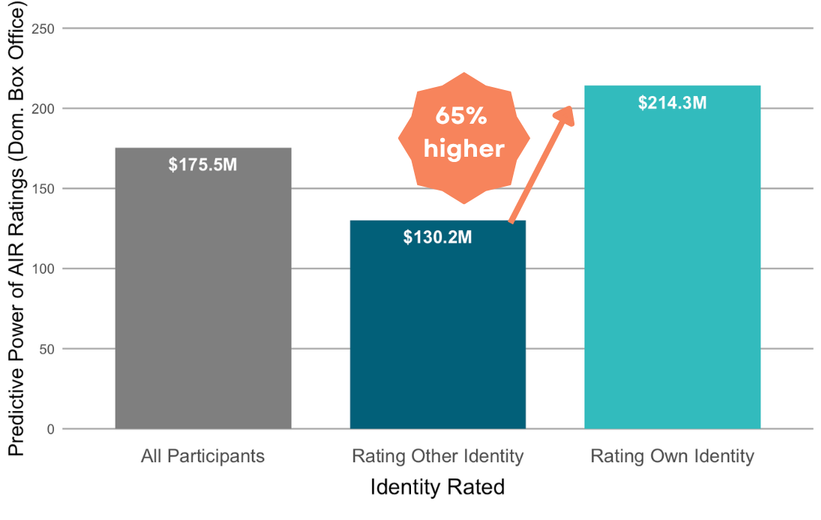
Adolescents rating representation of their own identity predicted box office success 65% better than adolescents rating identities they don’t share.
Adolescents with lived experience of an identity seem to be experts on representation of that identity by age 13.
Lessons from Gen Z: Three “fatal flaws” in representation, what drives good representation, and one last point about the stakes of good representation
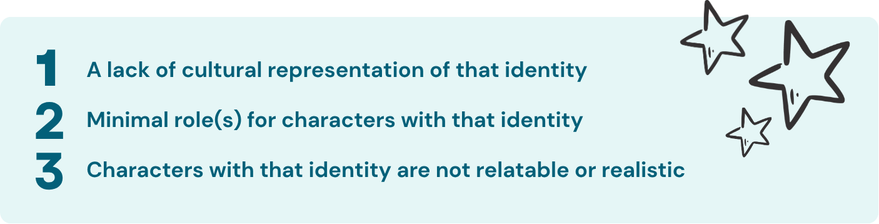
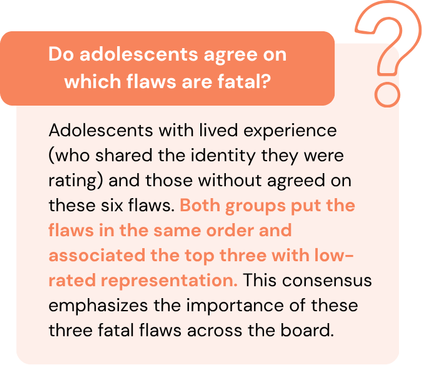
According to adolescents, these three things can doom the representation of an identity: (1) A lack of cultural representation, (2) minimal roles for diverse characters, and (3) unrelatable diverse characters.
But centering the relationships between diverse characters can help adolescents connect to them and bring to life the cultural representation.
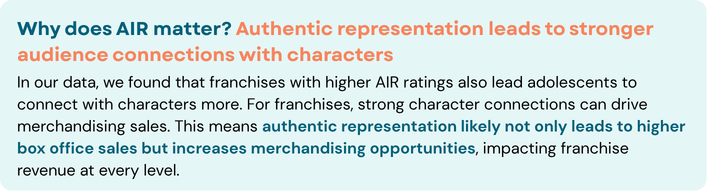
More authentic representation leads young people to connect more with the film’s characters, which can help drive financial success for franchises.

Today, the Center for Scholars & Storytellers (CSS) at UCLA released new research in our series on Authentically Inclusive Representation (AIR). Previous reports have shown that authentically inclusive representation, as rated by advocacy groups like GLAAD, Better Life Labs, Geena Davis Institute, and NHMC, leads to box office success - as well as higher critical and audience ratings of movies and shows. Our Roadmap to AIR report lays out 10 actionable tips to create a production process that leads to more authentic representation. Click here to read our other AIR reports.
View our press release for this project from UCLA’s newsroom here.
How to Cite This Report:
Puretz, M., Ibarra, H., Abazari, L., Hines, A., & Uhls, Y. T. (2025). Real Recognizes Real: Adolescents on Authentic Inclusive Representation in Film Franchises. Center for Scholars & Storytellers. https://www.scholarsandstorytellers.com/air-adolescents
Report Design: Whitney Jackson
Research shows that diverse representation pays at the box office, but especially in higher budget franchise films, studios are reluctant to risk casting diverse leads. Given how much young people are a key demographic for film franchises, and the prior evidence that authentic representation matters at the box office, we wanted to test if asking adolescents to rate representation in franchise films could potentially reduce the financial risk. CSS partnered with global insights and strategy firm, National Research Group (NRG), to survey 12,180 adolescents aged 13-24 via syndicated tracking. Adolescents (ages 13-24) today are not only more diverse than any prior generation, they have also grown up in a media environment that shows more diversity than previous generations got to see. All that exposure builds fluency. We would expect that adolescents, despite their age, are savvy consumers of media with representation of people of color, LGBTQ+ people, and women. So we asked them to evaluate representation in major film franchises, and compared that to franchise box office success. The real question we wanted to know: can asking adolescents about representation help studios make hit franchises?
Adolescents pick winners
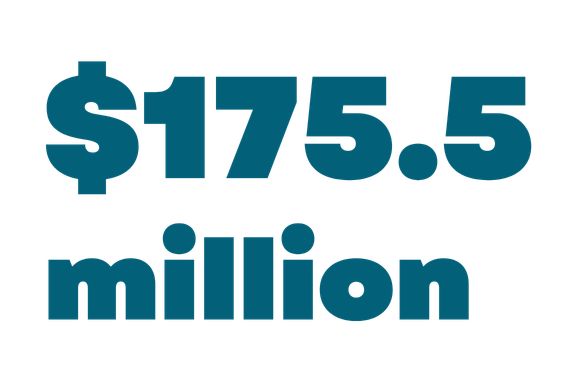
The more positively that adolescents rated the representation of people of color, women, or LGBTQ+ people, the more box office success the franchise had.

—the difference in average box office earnings per movie between a franchise that adolescents said represented a diverse identity in an “Average” way (3 out of 5) and one that represented it “Somewhat well” (4 out of 5).
We found this pattern across types of representation and movie genres, so we expect that the pattern would continue beyond these types of identities. In other words, portraying a diverse identity well enough that adolescents consider it above-average representation really pays off.
For instance, adolescents felt that Strange World, which grossed just $38 million at the domestic box office, does not rate highly either for its depiction of women (3.47/5.00 on average) or LGBTQ (3.33/5.00) characters. By contrast, adolescents rated the representation of women in The Incredibles franchise, which brought in an average of $435 million per movie in domestic earnings, pretty highly (3.72/5.00), especially the Violet character. This example illustrates how much these findings hold true even for the identities of supporting characters – authentic representation pays off across roles.
In our recent Teens & Screens report, we found that adolescents rank “people with lives like my own” as the number 1 topic they want to see in the media. For adolescents with diverse identities, that means authentic representation. But other adolescents want to see diverse representation too: Deloitte Research found that nearly 70% of audiences want to watch media that can “help them learn about cultures different from their own”. If it’s authentic, diverse representation has very broad appeal.
For adolescents, lived experience is the strongest signal
The importance of having lived experience (in other words, having the relevant identity, such as a girl rating female representation) came across clearly in the data - they are experts, even at a young age.
Ratings from adolescents who share the identity they were rating predicted box office success 65% better than adolescents rating identities they don’t share.
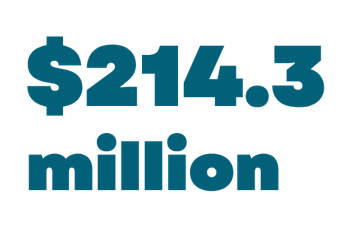
— the difference in average box office earnings per movie between a franchise that adolescents with lived experience said represented their own identity in an “Average” way (3 out of 5) and one that represented it “Somewhat well” (4 out of 5).
Plot showing that adolescents with lived experience (rating their own identity) are the best at identifying authentic inclusive representation that leads to box office success. The average for all participants (Finding #1) is shown for reference.

Did you know?
Our data show that adolescents as young as 13 gave representation ratings similar to 24-year-olds, but only if they both shared the identity being portrayed. As they age through their teenage years, adolescents rating an identity they don’t share start to agree more with experts, because they’re learning about representation. But adolescents with lived experience (rating their own identity) do not align themselves with experts more, because they already had their own expertise by age 13.
The key takeaway is this: while adolescents are generally knowledgeable about authentic representation, having lived experience with a particular identity gives adolescents real expertise, as early as age 13. Even more than other adolescents, younger adolescents with lived experience have unique, informed opinions about representation, and studios are losing money if they aren’t hearing those opinions.

Lessons from Gen Z - Three “fatal flaws” and what drives good representation
To better understand their unique perspective, we looked closer at what specific characteristics of diverse representation adolescents are tuning in to.
The three mistakes that adolescents associate most with poor representation
After rating the representation in each franchise, adolescents identified its main flaw. Out of six potential flaws to choose from, there were three “fatal flaws” that adolescents associated with low-ranked representation:
What makes these flaws “fatal”?
On average, if two adolescents rated the same franchise and one felt like the main flaw was a fatal flaw (e.g. a lack of cultural representation) and the other was not (e.g. a stereotypical character), the adolescent who noted a fatal flaw would consistently rate the franchise’s representation lower.
Gen Z Authors Respond


Read the full report below to access additional research insights, graphs and quotes on why the industry should listen to adolescents.
Authors
-

Matt Puretz, M.A.
Senior Researcher
-

Hana Ibarra
Research Assistant
-

Leah Abazari
Research Assistant
-

Alisha J. Hines, PhD
Vice President of Research & Programs
-

Yalda T. Uhls, MBA, PhD
Founder and CEO
Acknowledgements
Special Thanks to:


We would like to deeply thank the following contributors:
To the National Research Group (NRG), whose data powered this research.
To the Funders for Adolescent Science Translation (FAST), for supporting this research.
To Whitney Jackson, whose design elevated and brought to life this important research.
To Haidy Mendez and Nina Linhales Barker, whose web design and coordination made dissemination of this report possible.
To every adolescent participant who lent their voices toward this research. We hope that you feel seen and heard through this report.
For more information about the methods or details about this study, please contact us at info@scholarsandstorytellers.com.
Methodology
-
The purpose of this study was to test whether adolescents are an important and potentially overlooked authority on diverse representation in modern film, especially for franchises whose success depends on young people.
To conduct this study, CSS partnered with global insights and strategy firm, National Research Group (NRG), to survey 12,180 adolescents aged 13-24 via syndicated tracking. Franchise IQ is NRG's always-on syndicated tracker focused on entertainment franchises. It is in the field every week in the US, interviewing 3,500 general entertainment consumers per week. Semi-annually fielding 5,000 consumers internationally, FIQ has conducted over 1.3 million interviews globally with measurement on nearly 1,300 franchises. These franchises have touchpoints across key verticals including toys, gaming, streaming, television, and theatrical. Each franchise, including those featured in this report, is defined holistically - when respondents are asked about Spider-Man, for example, they are answering about their feelings toward the Spider-Man franchise as whole, encompassing its comics, movies, television series, etc.
-
Our final sample included 23,284 participants ranging in age from 13 to 24 years old. Participants ranged broadly across this age span, with representation from each age cohort between 13 and 24. Each age category had a minimum of 1,017 participants in it. Additionally, each franchise had at least 485 participants who rated it. The racial composition of the sample included respondents identifying as White (54.4%), Hispanic and/or Latino (20.9%), Black or African American (15.8%), Native American or Indigenous (4.5%), Asian or Asian American (2.5%), and Middle Eastern or North African (1.0%), with smaller proportions identifying as another race (0.6%) or preferring not to answer (0.2%). Overall, 2.5% of respondents identified as multiracial. Regarding gender, 50.5% of participants identified as female, 48.4% as male, and 1.2% identified as another gender identity or preferred not to answer. In terms of sexual orientation, 35.5% identified as heterosexual/straight, 8.0% as bisexual, and 2.7% as gay or lesbian, while smaller proportions identified as other (0.8%) or questioning (1.1%), and 52.0% of respondents preferred not to disclose their sexual orientation.